
The Secret Life of the Salt Marsh: A Lowcountry Love Letter from the Crew at Outside Hilton Head
Let’s get something out of the way right up front. The first time you meet a Lowcountry salt marsh at low tide, your nose is going to file a formal complaint.
There is a smell. We will not pretend otherwise.
It is the perfume of mud and minerals, of sulfur and seaweed, of approximately ten million tiny living things doing ten million tiny living-thing jobs all at once. We at Outside Hilton Head call it eau de pluff mud, and after about fifteen minutes on the water, we promise you will start to like it. After thirty, you will miss it when it is gone.
Because that smell is the sound of the marsh working. It is photosynthesis and decomposition and a billion bacteria clocking in for the morning shift. It is the engine room of the entire Lowcountry, humming away under the surface while egrets pose for postcards on top.
And it is hands-down the most extraordinary ecosystem you have never really looked at.
A Quick and Painless Marsh Primer
Before we get to the fun part, where we put you in a boat or on top of a paddleboard and turn you loose on this watery wonderland, let’s get the science out of the way. We promise to keep it short.
Our interpretive naturalist guides have a saying: “The science is the seasoning, not the entrée.” Nobody wants a lecture on their vacation. But knowing just a little bit about what you are looking at turns a pretty view into a full-on plot twist.
The Headline
The tidal salt marsh that wraps around Hilton Head Island is one of the most productive ecosystems on Earth. Pound for pound, acre for acre, this muddy, grassy, mosquito-skeptical landscape produces more biomass than a tropical rainforest.
Yes, you read that right. The unassuming sea of green you see from the bridge is, biologically speaking, an absolute overachiever.
Meet the Star of the Show: Spartina
The star of this show is a tall, skinny grass called Spartina, or Sporobolus alterniflora, also known as smooth cordgrass, also known as “that stuff that’s everywhere.”
Spartina is a botanical superhero with a wardrobe of unglamorous green. It does something almost no other plant on the planet can pull off: it lives, thrives, and parties in salt water. Every day, twice a day, the tides flood in and bury Spartina up to its eyebrows in brackish soup. And every day, twice a day, Spartina shrugs and keeps growing.
How? It has tiny salt glands on its leaves that literally sweat the salt out. Run your fingers along a Spartina blade on a hot afternoon, and you will feel it: a fine grit of crystallized salt, like a margarita rim built by the plant itself.
We may have told that joke before, and we will probably tell it again.
Why Spartina Matters
Spartina is not just surviving the marsh. It built the marsh. It does the heavy lifting in several ways:
- Roots trap sediment and stabilize banks
- Slows erosion
- Creates the spongy peat that the entire ecosystem stands on
- When it dies back each winter, it breaks down into detritus, a nutrient-rich slurry that is basically the protein shake of the salt marsh food web
Detritus feeds tiny critters. Tiny critters feed slightly bigger critters. Slightly bigger critters feed shrimp, crabs, and fingerling fish. And those? Those feed pretty much everything else in the Atlantic Ocean.
Which brings us to the most important thing we will tell you all day.
The Marsh Is a Nursery, and the Ocean Is the Graduate Program
If you have ever ordered shrimp and grits in Bluffton, blackened grouper in Beaufort, or a flounder sandwich anywhere south of Charleston, please pause and tip your hat to a salt marsh. You owe it dinner.
Estimates vary, but biologists generally agree that somewhere around 75% of the commercially and recreationally important fish and shellfish species in the South Atlantic spend at least part of their lives in tidal marshes.
Born, raised, fed, and hidden right here:
- Shrimp are born here
- Blue crabs grow up here
- Spotted seatrout, red drum, flounder, mullet, menhaden, and dozens more species use the marsh as a daycare, a buffet, and a hideout from bigger predators
The marsh is, for all intents and purposes, the maternity ward and elementary school of the Atlantic Ocean. Everything that’s anyone in the sea got its start in a place exactly like this one.
This is not the kind of fact you can really feel from a postcard. You have to be on the water. You have to see a school of finger mullet detonate off the surface like buckshot, chased by a redfish hunting in eight inches of water. You have to watch a tiny sheepshead minnow defending its postage-stamp of marsh edge like it is the king of England.
You have to drop your hand into the water and flip over a crab-pot buoy, encrusted with sea squirts and garlic sponges and tiny skeleton shrimp living rent-free, and realize you are holding an entire civilization.
It is a lot. It is also free, if you know where to look. That last part is where we come in.
Why You Will Miss the Magic if You Go It Alone
Here is an honest confession from the Outside Hilton Head crew. We love a self-guided adventure. We love when people grab a kayak rental, slap on a hat, and just go. We are not gatekeepers, and we are not snobs about it. The marsh belongs to everyone.
But.
There is a difference between being on the marsh and seeing the marsh. The first one is delightful. The second one is life-changing. And the gap between the two is filled with all the stuff our captains and naturalist guides have spent their careers learning to point out.
What a Guide Sees That You Do Not
- An oyster reef: A first-timer sees a pile of shells. Our guide points out the periwinkle snails climbing the Spartina ahead of the tide, the mud crab hiding in a knothole, and the marsh wren stitching together a nest the size of a tennis ball.
- A heron: A boater thinks, “Cool, a bird.” Our captain tells you it is a tricolored heron, that it hunts by stirring up the bottom with a yellow foot, and that it is standing exactly where it is because the tide is dropping and the killifish are funneling through that exact creek mouth right now.
- A dolphin: A self-guided guest sees a dolphin. Our crew sees a specific dolphin. We probably know its name. We almost certainly know its mother. We have stories.
That is the difference. The marsh is a story. We have been reading it for a long time, and we love nothing more than reading a few chapters out loud to people who are seeing it for the first time.
Three Ways to Read the Marsh
There is no single best way to explore a salt marsh. There are three, and the right one depends on the day you want to have. Lucky for you, our fleet covers all of them.
By Boat: The Big Picture
If you want to cover ground, see big animals, and get a sense of the sheer scale of what we have going on out here, a boat tour is your move. We are talking dolphin tours, sunset cruises, history-and-ecology runs through the Calibogue Sound and Broad Creek, and offshore trips to Page Island or Daufuskie Island.
The boat is where you understand the geography. From the water, you will see how the marsh is not just one thing. It is a maze of creeks, mud flats, hammocks, and oyster bars, all stitched together by tides that move five to eleven feet up and down twice a day.
Twice. A. Day.
Whole landscapes appear and disappear before lunch.
Boat tours are also where you will most likely have your dolphin encounter. Bottlenose dolphins are year-round residents here, and Hilton Head dolphins are special: they are one of only a handful of populations in the world that practice strand feeding, a behavior where they coordinate as a pod, push a wave of mullet up onto a mud bank, and then beach themselves to grab the fish before sliding back into the water.
It is wild, smart, terrifyingly precise, and so cinematic you will forget to breathe. Our captains know where strand feeding is most likely to happen, and on the right tide, the right day, with the right vibes, you might just see it.
We will not promise. The marsh does not take requests. But we will get you in the right place.
By Kayak: The Close-Up
If the boat is the wide shot, the kayak is the close-up. This is where the marsh starts whispering instead of shouting.
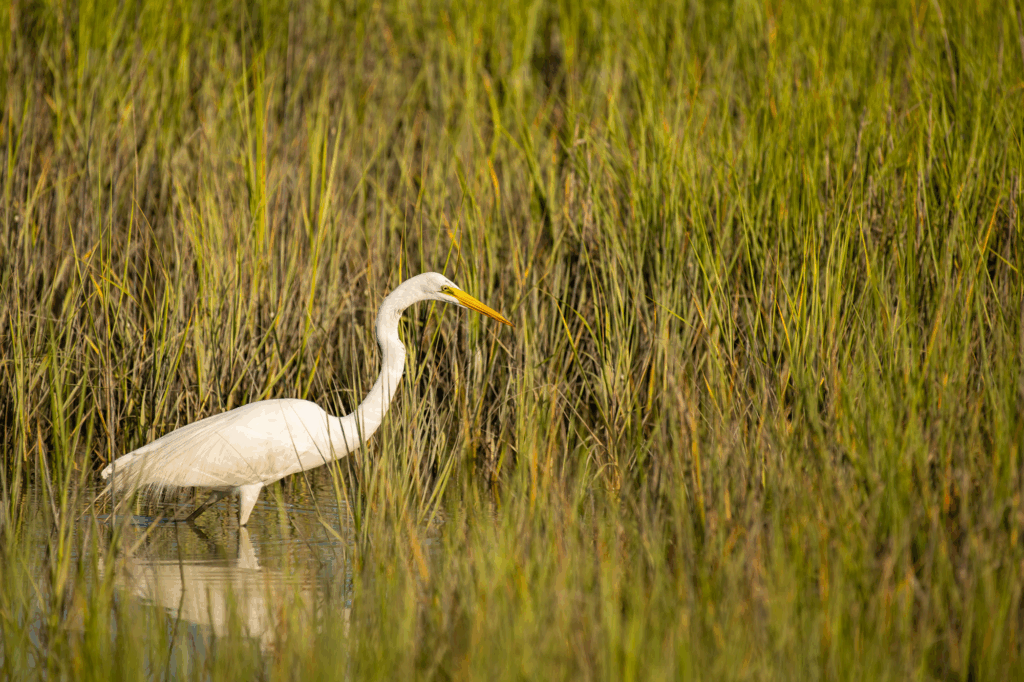
Picture this. You are sitting low in the water. The sun is doing that golden, late-afternoon thing. A great egret is hunting on a mud flat ten feet off your bow, and he is so unbothered by your existence that you start to wonder if you have become invisible. A school of mummichogs flickers past your paddle. A blue crab does a sideways sprint along the bottom. From up here, the marsh grass is taller than you are, and you realize the world has gone quiet in a way you did not know was still possible.
Kayaking is our crew’s secret favorite. The boats sit just a few inches above the water, and that low angle changes everything.
From a kayak you can:
- Slip into creeks too narrow for a powerboat
- Hover over an oyster reef and watch the snails climb
- Hear the popcorn-crackle of a billion snapping shrimp doing whatever it is snapping shrimp do down there, which is mostly snapping, loudly, with one giant claw
Our guided kayak tours come in flavors:
- Sunrise glides for the early birds and the photographers
- Sunset paddles for the soft-light romantics
- Family-friendly creek tours for the wiggly ones
- Longer expeditions for the people who want to push deeper into the maze
All of them come with a naturalist who can tell you exactly what that splash was, what made that track in the mud, and why the fiddler crab is waving at you.
Spoiler: he is not waving at you. He is waving at the lady fiddler crabs. Sorry to disappoint.
By Paddleboard: The Stealth Mission
The paddleboard is the ninja option. Standing up, gliding silently, casting almost no shadow, you become weirdly invisible to wildlife in a way that even kayakers cannot match. Birds will not flush. Fish will swim under your board. We have had paddlers tell us they watched a bonnethead shark cruise between their feet, and they are still telling that story at dinner parties three years later.
Paddleboarding the marsh is also a different kind of physical experience. It is not white-knuckle. The marsh is a sheltered, protected world, especially at the right tide, and our guides pick routes that match the conditions.
But you will use muscles you did not know you had. You will feel the tide as a current under your feet. You will notice your breath syncing up with your paddle stroke. By the end of an hour, you will feel like the marsh has rinsed something off you that you did not even know was on there.
Bring a waterproof phone case. You will want to take pictures. You will also want to put your phone away after a while.
The Cast of Characters
Every story needs characters. The marsh delivers a full ensemble.
The Headliners
- Bottlenose dolphins, of course
- Bald eagles riding the thermals
- Ospreys diving like cruise missiles
- The occasional manatee in summer, our gentle floating baked potatoes
- Loggerhead and Kemp’s ridley sea turtles cruising the inlets
The Locals
The wading birds, doing their slow heron work, all the time:
- Great blue herons
- Snowy egrets
- Tricolored, little blue, and green herons
- Yellow-crowned and black-crowned night-herons
- Wood storks looking like prehistoric extras from Jurassic Park
- Roseate spoonbills, in summer, looking like a flamingo made a jail break
The Tiny Weirdos That Steal the Show
- Fiddler crabs marching across the mud flats by the hundreds of thousands, the males waving their oversize claws like they are hailing cabs
- Mud snails clustered into living mosaics
- Periwinkle snails climbing Spartina blades to ride out the high tide, a behavior so reliable our guides use it to tell time
- Diamondback terrapins, the only turtle in North America that lives exclusively in brackish marshes, poking their delicate heads up between the grass blades
And Then the Hidden Ones
Things you will never see, but you should know are there:
- The marsh hen, technically a clapper rail, calling like a maraca from somewhere deep in the Spartina
- Juvenile flounder lying flat on the bottom, perfectly camouflaged
- Shrimp doing their nighttime migrations through creek mouths so dense the water looks like soup
Every single one of these creatures has a story. Why it is here. What it eats. Who eats it. How it survives the heat, the salt, the tides, the predators, the seasons.
That is the kind of stuff our naturalists live for. Ask them anything. Seriously, anything. We have a guide who knows more about marsh periwinkles than most people know about their own families.
A Few Practical Notes from People Who Live Out Here
We will keep this part short, because we have already written separate blog posts about what to wear for a day on the water and how to handle the Lowcountry heat, and you should absolutely read both before you come.
Short version: the sun out here is not playing. The water reflects it. The marsh holds it. You are a small mammal, and the sun is a star, and stars win that argument every single time.
Quick Reminders
- Light, breathable, long-sleeved layers. Sunburn on the back of your neck while paddleboarding is a Hilton Head rite of passage we wish you would skip.
- Hat. Brimmed, secured with a strap, and please not your nicest one.
- Water shoes or sport sandals. Pluff mud is a love language, but barefoot is not the move on an oyster reef. Those shells are sharp.
- Polarized sunglasses. Without them, the surface of the water is a mirror. With them, you will see the stingray gliding under your kayak. Worth every penny.
- Water. Twice as much as you think you need, especially July through September. Hydration in the Lowcountry is not optional. Powdered electrolyte mix-ins are also a good idea.
- Sunscreen, but please go reef-safe. The marsh is not a coral reef, but it is a nursery for things that matter. Our oyster reefs and inshore fish life would prefer not to wear your old-school zinc cocktail.
- Bug spray for dawn and dusk. The no-see-ums are tiny, mighty, and always recruiting.
- A sense of humor. You may get muddy. You will probably get splashed. Your hair will not survive. The wildlife is not on the schedule and the tide is its own boss. Roll with it.
The Marsh Will Be There Tomorrow. We Wish It Would Always Be.
Here is the part where we get a little serious for a minute. The salt marsh is one of the most resilient ecosystems on the planet, and also one of the most fragile. Sea level rise, coastal development, water quality, and changing weather patterns are all rewriting the marsh’s rules in real time.
The marsh has been here, in some form, for thousands of years. It would like to be here for thousands more.
The most important thing we can do at Outside Hilton Head is help people fall in love with the marsh. People protect what they love. They love what they understand. And they understand what a good guide takes the time to show them.
That, more than anything, is why we do this.
Come See for Yourself
Look, we could keep writing. We could tell you about:
- Paddling in a kayak under a full moon so luminescent that the marsh lights up with a silver glow as you listen to the “phhffft” exhale of dolphins surfacing all around
- The marsh in October, when the Spartina turns gold and the light gets so long and slow you forget what season you thought you were in
- January, when the migrating ducks pour in and the marsh gets quiet and crisp
We would rather show you.
Whatever your speed, whatever your group, whatever your idea of a perfect day on the water, we have a captain or a guide who has been waiting all season to take you out:
- Boats for the big-picture people
- Kayaks for the close-up people
- Paddleboards for the people who want to disappear into it
And every single trip comes with a naturalist who lives for the moment your eyes go wide at something they have shown a thousand guests and never once gotten tired of pointing at.
Because the marsh is a story, and the best stories are the ones told out loud, with the wind in your hair and the sun on your shoulders and the water lapping at the side of your boat.
The tide is dropping. The wrens are waking up. The oysters are open for business.
The marsh is ready when you are.
Explore our boating tours, Dolphin Eco Tour, Guided Kayak Nature Tour, and kayaking and paddleboarding experiences to find the right way to experience the Lowcountry salt marsh.